CASE STUDY · HOW WE BUILT IT

Every hire runs through people who never see the same screen. We built the system that still gets them to yes.

The candidate was the applicant. The problem class was coordination across everyone a hire depends on: a recruiter sourcing, a coordinator running the search, managers deciding, stakeholders weighing in, observers watching, and an applicant who never logs in at all. Each works in a different tool and sees a different slice, and the hire stalls in the space between them. That is the same class every enterprise approval runs on. What follows is how we framed the gaps and what we built to close each one.

Before we designed a screen, we mapped the people. A recruiter feeding resumes in from anywhere. A coordinator who owns the whole search. Hiring managers who decide but do not drive it. Stakeholders who vote on some roles and never see compensation. Observers who only comment. And the applicant, who never logs in at all. We mapped what each one could see, what each could decide, and where the search stalled while it waited on them. Then the question that drives every BL engagement: in the moment a decision needs to be made, where is the gap between what is known and who can act on it?

What follows is how we closed five of those gaps.

Actor landscape  ·  One open role
BL Operator Admin
HR Coordinator Owner
Hiring Manager Link
Stakeholder Vote
Observer View
Applicant Token
01 · INTAKE

The brief gets re-argued with every resume

Five people hold five definitions of the same role. Compensation, the required qualifications, and what good actually looks like are agreed in a kickoff and then quietly relitigated with every new resume. A role without a locked brief drifts, and the drift is invisible until the search is three weeks old with nothing to show for it.

We built a structured intake that locks the brief before a single resume is read: the compensation range, required versus preferred qualifications kept explicitly apart, the approval chain named upfront, and the exact prompts each manager will answer. The definition stops moving, so everything downstream is measured against the same bar.

Where this transfers: any multi-stakeholder spec that is never locked. Statements of work, product requirements, grant criteria, anything a committee agrees to and then relitigates one exception at a time.
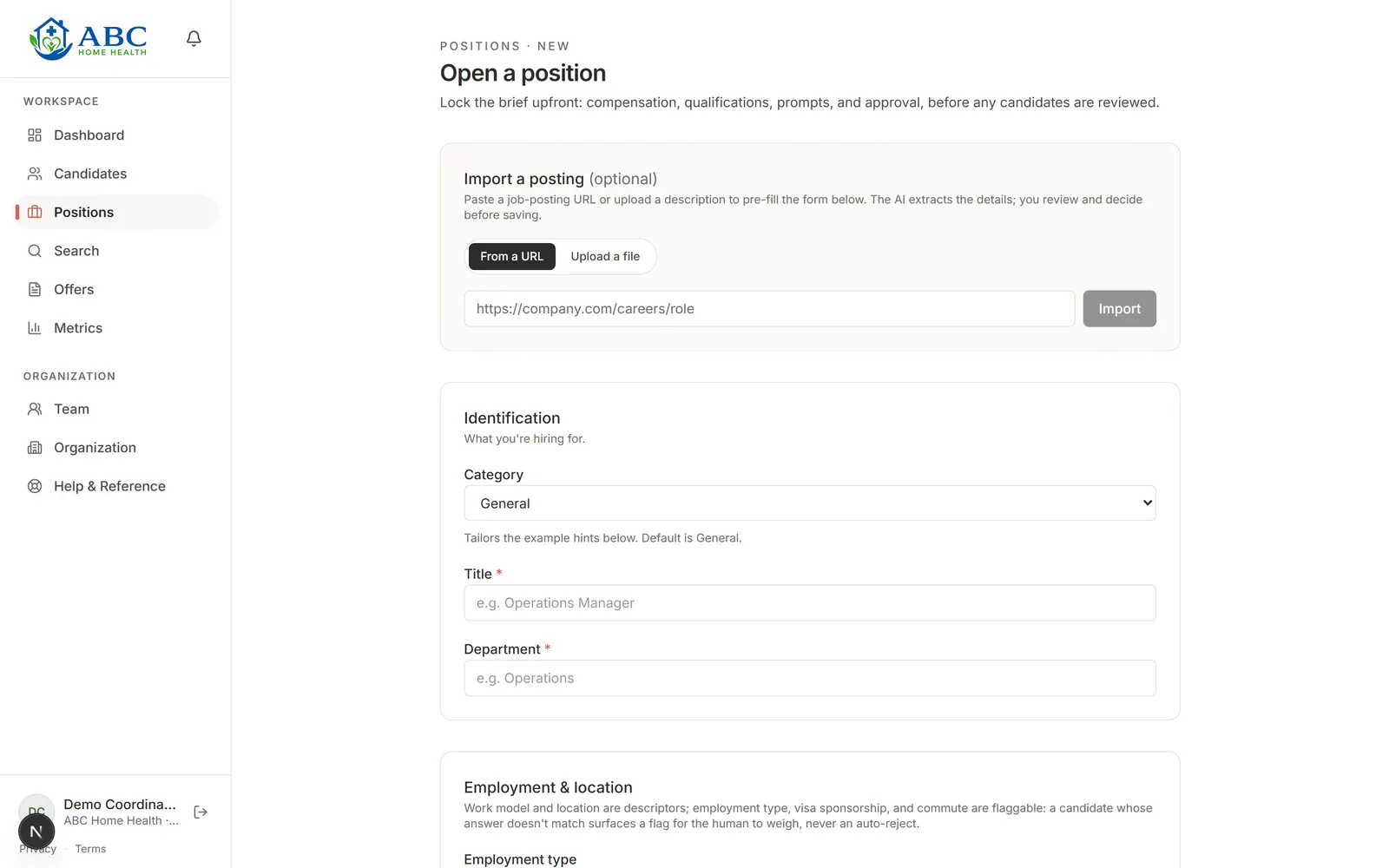
Hireware new-position screen: Open a position and lock the brief upfront, including compensation, qualifications, prompts, and approval, before any candidates are reviewed
STRUCTURED INTAKE · BRIEF LOCKED BEFORE REVIEW
02 · SCREEN

AI that reads, and refuses to decide

Filtering two hundred applications down to a shortlist is manual, slow, and inconsistent between reviewers and between Mondays. The obvious fix is to let software score and rank the pile. We deliberately did not build that.

Hireware's AI extracts facts, matches the required criteria, and surfaces five structural flags: title against described responsibility, credentials, employment gaps, buzzword targeting, and short stints. It never ranks, scores, or recommends, by model or by math. A coordinator reads every flag and makes the call. That constraint is engineered on purpose. It keeps a person accountable for every employment decision, and it keeps the system outside automated-decision regulation like NYC Local Law 144.

Where this transfers: any high-volume triage where a machine can flag but a human must own the outcome. Lending, claims, admissions, compliance review, anywhere a score would create exposure the business cannot carry.

Hireware AI screening tab: five structural checks on the resume, described as not a hiring judgment and a coordinator makes the call, with eligibility flags to review and never an auto-reject
AI FLAGS · A PERSON DECIDES
03 · COORDINATE

The manager's opinion lives in an email that never comes back

A coordinator owns the search, but the decision needs people who do not: hiring managers, stakeholders, observers. Chase them by email and the input arrives late, unstructured, and missing the context that made it useful. Give them all a full login and most never sign in.

We built one review model with six roles and the right amount of friction for each. A manager can answer three structured prompts from a single magic link with no account at all. Stakeholders vote on their assigned roles and see compensation only when the manager grants it. Observers comment and nothing more. Every vote and comment lands back on the candidate, attributed and time-stamped, so the coordinator always knows who has weighed in and who is holding up the room.

Where this transfers: any review that depends on busy people seeing different slices of the same record and responding in a way you can actually track. Loan committees, clinical sign-offs, procurement approvals.
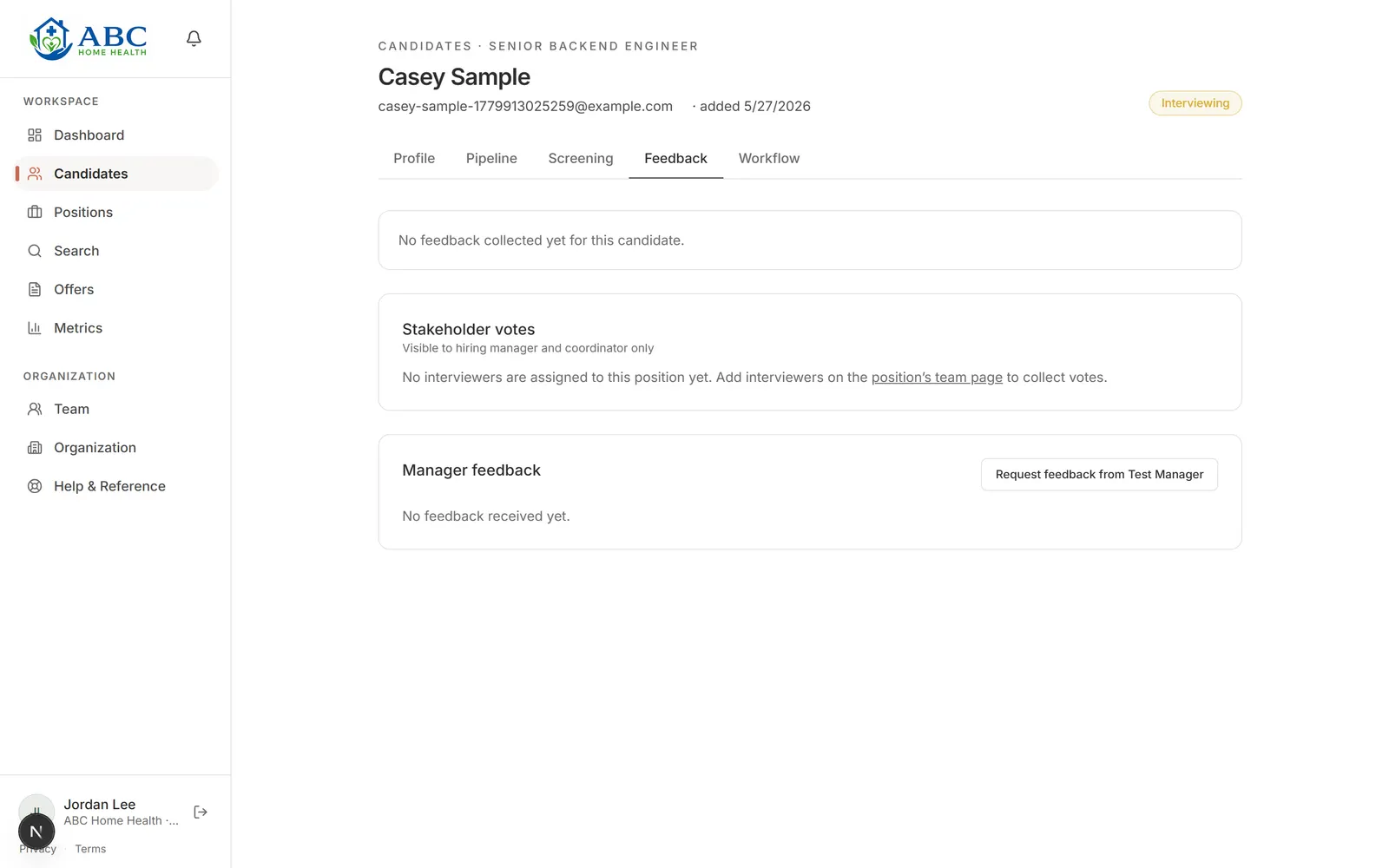
Hireware candidate feedback tab: stakeholder votes visible to the hiring manager and coordinator only, and a manager feedback request, all collected on one candidate record
MANAGER + STAKEHOLDER FEEDBACK · ONE RECORD
04 · AGGREGATE

No one holds the whole board

Across several open roles, every reviewer, and every stage, no one has the whole picture. Status lives in one person's inbox, another's spreadsheet, and a third's memory. A role can sit untouched for four weeks and no one notices until the candidate is already gone.

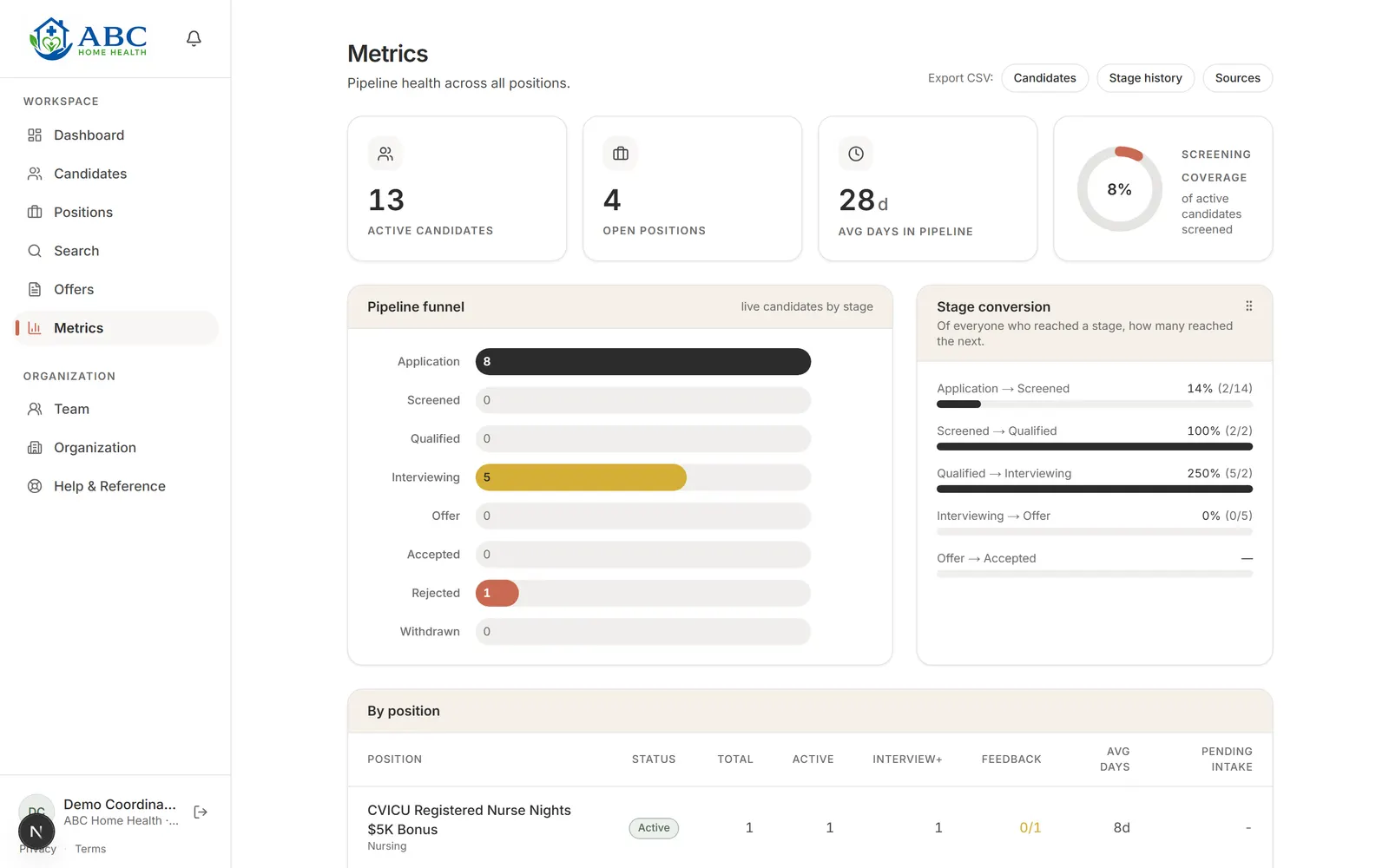
We built the coordinator's command center: a single board showing the priority queue, every open position, and the candidates waiting on a decision, with stalled roles flagged the moment they go quiet. A candidate marked interviewing 35 days, no movement surfaces on its own. Behind it, one metrics view tracks pipeline health across every role. One source of truth, the whole search at a glance.

Where this transfers: any operation where status is scattered across people and tools and the cost of a dropped thread is high. This is the same fragmentation problem, now measured in people instead of data formats.
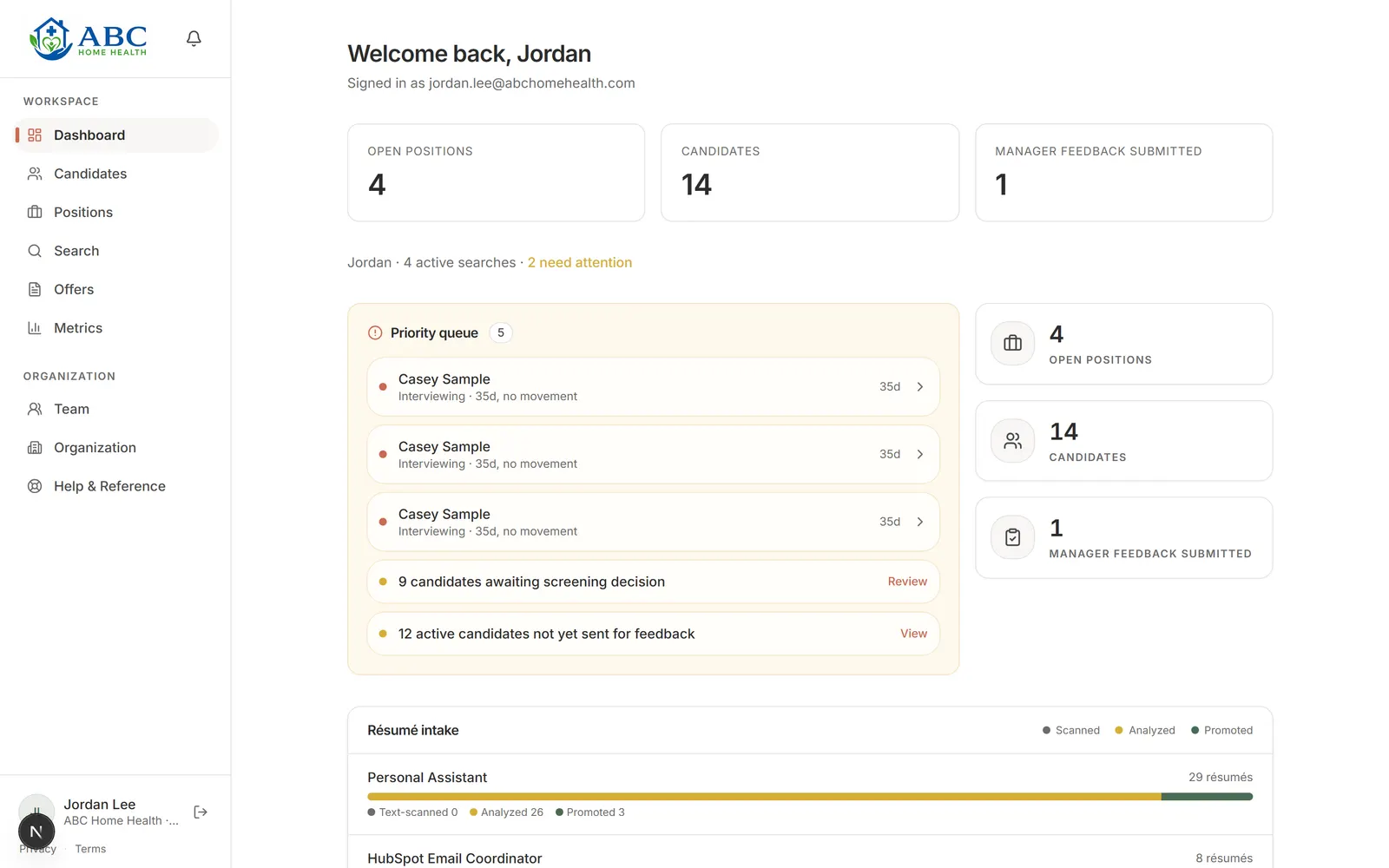
Hireware coordinator dashboard showing open positions, candidate counts, manager feedback submitted, and a priority queue flagging a candidate interviewing 35 days with no movement
COORDINATOR DASHBOARD · THE WHOLE SEARCH AT A GLANCE
Hireware metrics view showing pipeline health across all positions: active candidates, open positions, average days in pipeline, screening coverage, a pipeline funnel, and stage conversion rates
PIPELINE METRICS · HEALTH ACROSS EVERY ROLE
05 · CLOSE

The decision is made, then the candidate takes another offer

The most expensive failure in hiring happens after the decision. The team says yes, and then compensation gets reviewed, approvers get chased, the letter gets drafted, and days pass. In those days a competing offer arrives, and the candidate you chose is gone.

Because compensation was locked and the approval chain was named back at intake, the offer has nowhere to stall. It routes straight to the people who already agreed to sign, and yes becomes a signed letter before the gap can open. Closing that offer-to-close gap is the whole point of the product.

Where this transfers: any process where the decision is made but execution lag loses the outcome. Contract sign-off, procurement, loan closing, anywhere the yes and the signature are days apart.

Hireware candidate workflow stepper moving from Application through Screened, Qualified, and Interviewing to Offer and Accepted, with a stage timeline showing time in each stage
STAGE WORKFLOW · APPLICATION TO SIGNED OFFER

If your work stalls because it waits on people, we can work it out with you.

The vocabulary changes. Yours might be a loan that waits on an underwriter, a claim that waits on an adjuster, a contract that waits on legal, or a purchase that waits on three approvers who never see the same version. The problem class is the same: several people, each with a partial view, each in a different tool, all responsible for one outcome that stalls in the space between them.

We don't sell a platform. Hireware is the one we built for hiring, because we lived that problem for years. What we bring to your version is the same order of operations: map the actors first, lock the decision second, build the surface third, and keep a person accountable for every call that affects another person.

That is how Bessemer Legacy works. We listen to what is actually breaking in a business, then we build and run the application or service that fixes it. Hiring is one of those problems that quietly costs small businesses more than almost anything else, and it rarely gets solved well. We built Hireware for it, because we want to help.

If you can describe your version of this, we can work through it with you.

Get Started

Bring us the process that stalls between people.

We'll show you what it looks like as one operation that closes.

Start a discovery call See Hireware live at hireware.co →